
Let’s Talk About Your Business Needs832-618-3082
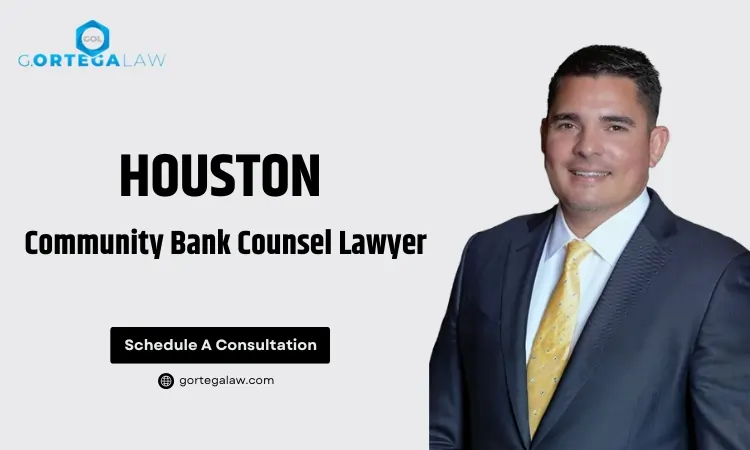
Running a community bank means balancing customer relationships, providing lending opportunities, and contributing to local growth, while keeping up with an increasingly complicated regulatory environment. When examination findings or governance questions arise, you need a Houston community bank counsel lawyer who understands the unique challenges that your community bank is facing.
At G. Ortega Law in Houston, Texas, we provide practical legal guidance on compliance, lending, corporate governance, vendor contracts, and disputes so your bank can manage risk while serving your customers with confidence.
At G. Ortega Law, PLLC, we have more than 25 years of experience in the banking and financial services industry, giving us a practical understanding of the challenges that community banks face every day. Our award-winning team is recognized for delivering reliable, results-driven service built on trust and responsiveness, and we’re ready to advocate for your needs.
In 2025, there were 3,953 FDIC-insured community banks across the United States, with some of the most popular in Houston being Lone Star Bank, Central Bank, and Golden Bank, NA.
Community banks face legal challenges that require more than generic business advice. Financial institutions need to comply with federal and state banking regulations while maintaining efficient internal processes and strong customer relationships. Our firm helps banks address these demands with proactive legal counsel. Our team advises on:
As a trusted law firm, G. Ortega Law, PLLC, offers quality community bank counsel attorneys for institutions that need timely and practical advice. Our team interprets community bank counsel laws in a way that supports sound business decisions while drawing on lessons from past cases.
Community banks operate under constant oversight from federal and state regulators. Even minor compliance gaps can lead to costly findings, enforcement actions, and reputational harm.
A Houston community bank counsel attorney from G. Ortega Law, PLLC, can help your institution prepare for examinations, respond to regulatory concerns, and strengthen your internal controls. We can help community banks:
As a trusted law firm, we provide responsive and practical legal counsel to help community banks navigate complex compliance requirements with confidence.
Community banks heavily depend on technology vendors to keep their operations running smoothly. These relationships carry both operational and legal risk, making clear, well-structured contracts and strong data security practices essential. Some of the key legal protections and compliance needs we focus on include:
At G. Ortega Law, PLLC, we work closely with bank leadership to protect collateral positions and confirm that vendor and cybersecurity arrangements are built on a solid legal foundation.
When you need to hire a community bank counsel lawyer, local legal representation can make a major difference.
Our legal team’s understanding is that when a community bank is facing regulatory pressure or governance challenges, timing and familiarity with the local legal landscape matter just as much as the law itself. Facilitated by our location, we’re deeply connected to how cases move through Houston’s local courts and how regional regulatory expectations are applied in practice.
Our team regularly practices at the Harris County Civil Courthouse, the Harris County Criminal Justice Center, and the United States District Court for the Southern District of Texas, Houston Division. This familiarity with local courts helps us anticipate procedural nuances, move matters more efficiently, and advocate more effectively for our clients at every stage of litigation.
Community banks should review their board policies at least annually, though high-risk areas like cybersecurity, anti-money laundering, and vendor management may require more frequent updates. Regular reviews can help make sure that your policies reflect changing regulations, expectations, and operational realities. It’s also important for directors to document all revisions and confirm that management has implemented any updated procedures.
The legal issues that could develop during a core processor conversion can include data ownership, contract termination fees, confidentiality issues, service disruptions, and vendor liability. Banks should carefully review their implementation obligations, testing requirements, and performance standards before signing any agreements. Our team can negotiate protections for delayed conversions, security incidents, and inaccurate data transfers.
Whether community banks can use artificial intelligence in lending operations depends on the service. Artificial intelligence may be used in underwriting and customer service, but there needs to be human monitoring of fair lending, privacy, and model risk concerns. If an institution wishes to utilize artificial intelligence in lending operations, it needs to validate the algorithms, document all decision-making criteria, and rigorously test for bias.
Before opening a new branch, banks should consider their regulatory approvals, lease terms, zoning requirements, staffing considerations, and technology infrastructure. Our team can help negotiate in real estate matters, coordinate with banking regulators, and develop vendor agreements related to security and telecommunications. It’s also important for banks to assess market conditions and the needs of the community.
At G. Ortega Law, PLLC, we advocate for community banks with a strategic approach that addresses the challenges and high-risk scenarios associated with regulatory scrutiny and governance issues.
Contact us today to schedule a consultation. transactions. We can assist with legal matters, reducing risks, and taking care of the details so you can focus on growing your business.


832-618-3082
Trusted Guidance, Just a Call Away
” * ” Indicates Required Fields
"*" indicates required fields
© 2026 G. Ortega Law, PLLC• All Rights Reserved. Disclaimer | Site Map | Privacy Policy. Digital Marketing By: 
*Images are obtained under license from Canva and other third-party stock image providers, with attribution included where required.